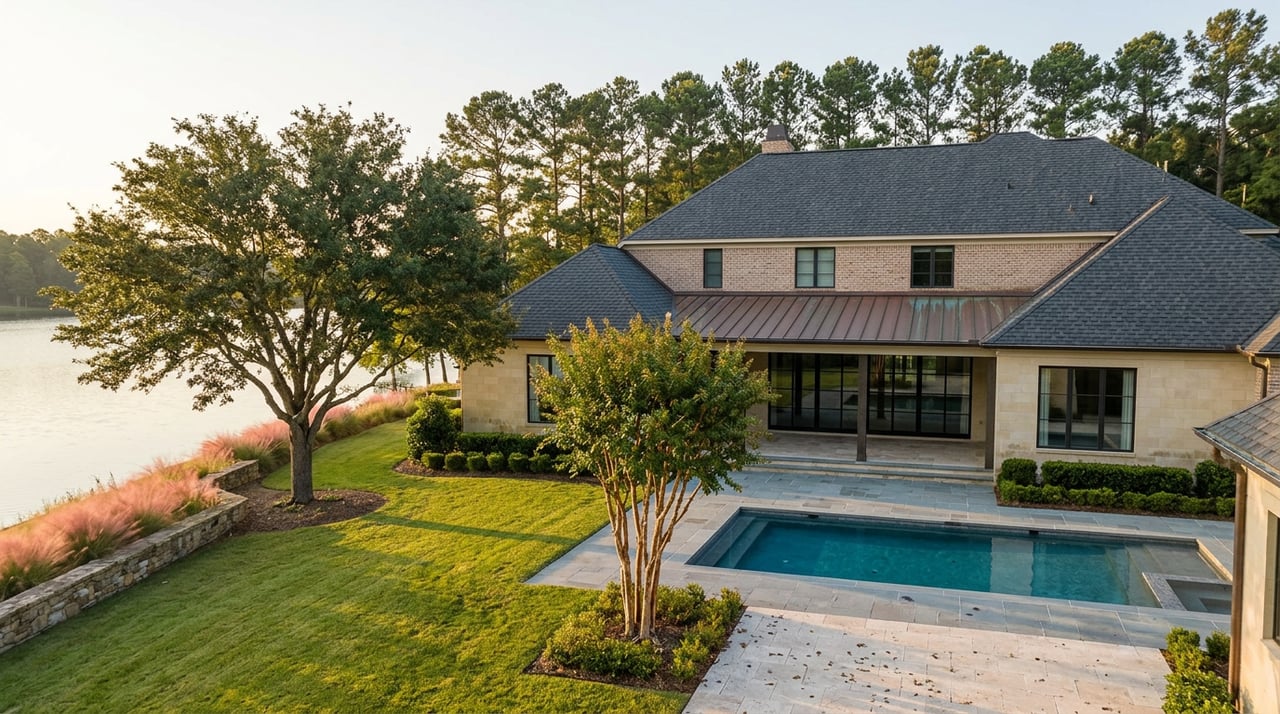
The Riverstone Closing Fee That Scales With Your Price Tag
September 3, 2026
September 3, 2026
Most closing costs in Riverstone are flat. Whatever you sell for, the HOA charges the same transfer fee and the same reserve fund fee, dollar for dollar, whether the home is a starter patio home or a waterfront estate in a gated section. One fee does not work that way. It moves with your sale price, and right now, with Riverstone's active listings sitting far above what's actually closing, that difference is bigger than most sellers expect.
I've walked enough Riverstone sellers through their settlement statements to know where the surprises hide. It's rarely the fee everyone Googles. It's the one that's easy to skip past on the resale packet because it's listed as a percentage instead of a number.
Riverstone's own resale documentation lays out a handful of standard charges tied to every sale. A buyer typically pays a $250 transfer fee and a reserve fund fee equal to whatever the current annual assessment happens to be. Both are fixed. It doesn't matter if the home sold for $500,000 or $2 million.
The seller's side is different. Riverstone charges a community foundation contribution equal to 0.25% of the sale price, collected at resale to fund community enhancements beyond routine HOA upkeep. That single line item is the only major fee on either side of a Riverstone closing that scales with price.
Here's what that actually looks like at three real Riverstone price points:
| Sale Price | Seller's Foundation Fee (0.25%) | Buyer's Flat HOA Fees (transfer + reserve) |
|---|---|---|
| $650,000 | $1,625 | $1,580 |
| $1,059,343 (average sold price, per June 2026 HAR data) | $2,648 | $1,580 |
| $1,824,340 (median active list price, as of August 31, 2026) | $4,561 | $1,580 |
At the entry point of the Riverstone market, buyer and seller pay roughly the same amount in HOA fees. By the time you're near today's median list price, the seller's foundation fee has grown to nearly three times the buyer's flat total. That's not a rounding difference. It's a structural fact about how this particular fee is built, and it means pricing decisions at the top of the Riverstone market carry a closing cost consequence that pricing decisions at the bottom don't.
That $1,824,340 figure is worth sitting with, because it points to something sellers preparing to list should understand before they anchor their expectations to it.
As of August 31, 2026, the median list price among active Riverstone listings sits at $1,824,340, with homes averaging 70 days on market and $309.40 per square foot. But HAR Neighborhood Facts data from June 2026 puts the average sold price in Riverstone at $1,059,343, with an average of $238.16 per square foot and an average size of 4,183 square feet.
That's a gap of roughly $765,000 between what's currently asking and what's actually trading. It doesn't mean the market has cooled. It means the pool of homes sitting on the market right now skews heavily toward Riverstone's luxury and waterfront inventory, the estate sections and gated enclaves that take longer to move and carry premium price tags. Meanwhile, the homes that are closing reflect a broader, more typical cross-section of the community.
For a seller pricing a home right now, that gap matters twice over. It affects where you land on comparable sales, and because the foundation fee scales with sale price, it affects what you'll actually net at closing if you price against today's aspirational listings instead of what's realistically closing.
The buyer's reserve fund fee isn't arbitrary either. It's set equal to whatever Riverstone's current annual assessment happens to be, which means it moves every time the HOA raises dues. That number has not stood still. Riverstone's annual assessment has climbed from roughly $1,110 in 2022 to about $1,208 in the years that followed, then to $1,310 in 2025, and now sits at $1,330 for 2026 according to Riverstone's published fee schedule.
That's a rise of about $220 over four years. It's a modest annual increase on its own, but it means the reserve fund fee a buyer pays at closing today is meaningfully higher than what a buyer paid closing on the same floor plan four years ago. If you're negotiating fee allocation on a resale contract, this is a number worth checking against the current year, not last year's packet.
The fees are only half the story. Riverstone's resale process runs on a clock, and if your closing timeline slips, that clock can cost you.
That last point is worth a conversation with your agent before you sign anything. Riverstone's default allocation is a starting point, not a rule.
If your closing lands in late November or December, ask one more question before you finalize numbers: whether next year's assessment gets swept into your payoff. Because the reserve fund fee tracks whatever assessment is currently in effect, a closing that straddles the calendar year can mean the buyer's reserve fund fee reflects a number that's about to change. It's a small timing detail, but it's exactly the kind of line item that turns into a last-minute phone call to the title company if nobody flags it in advance.
Does every Riverstone sale pay the foundation fee? Riverstone's resale documentation lists it as a standard seller charge collected at every resale, though your specific contract can reallocate it through the TREC addendum.
Who actually pays the $225 Certificate of Compliance fee? It's due upfront to place the order, typically arranged through the title company. Texas Property Code defaults the resale certificate fee to the buyer unless the contract states otherwise, so the party who fronts the $225 isn't necessarily the party who carries it at closing.
Can Riverstone charge more than $225 for the certificate? Texas law caps preparation fees for HOA resale certificates at $375 statewide, so Riverstone's standard $225 charge sits well under that ceiling. An update, if your closing runs past the 10-day validity window, is capped separately at $75.
Riverstone's fee structure rewards sellers who do the math early, especially at the higher end of the community where today's asking prices and today's closed sales are telling two different stories. If you're weighing where your home fits in that gap, or want a second set of eyes on a resale packet before you sign, I'd be glad to walk through it with you. Kristi Bajjali has spent years pricing and closing homes across Fort Bend County, Riverstone included, and knows exactly which line items deserve a second look. Let's Connect.
Stay up to date on the latest real estate trends.

Elevating the real estate experience for clients at every stage, from first-time buyers to luxury clientele.